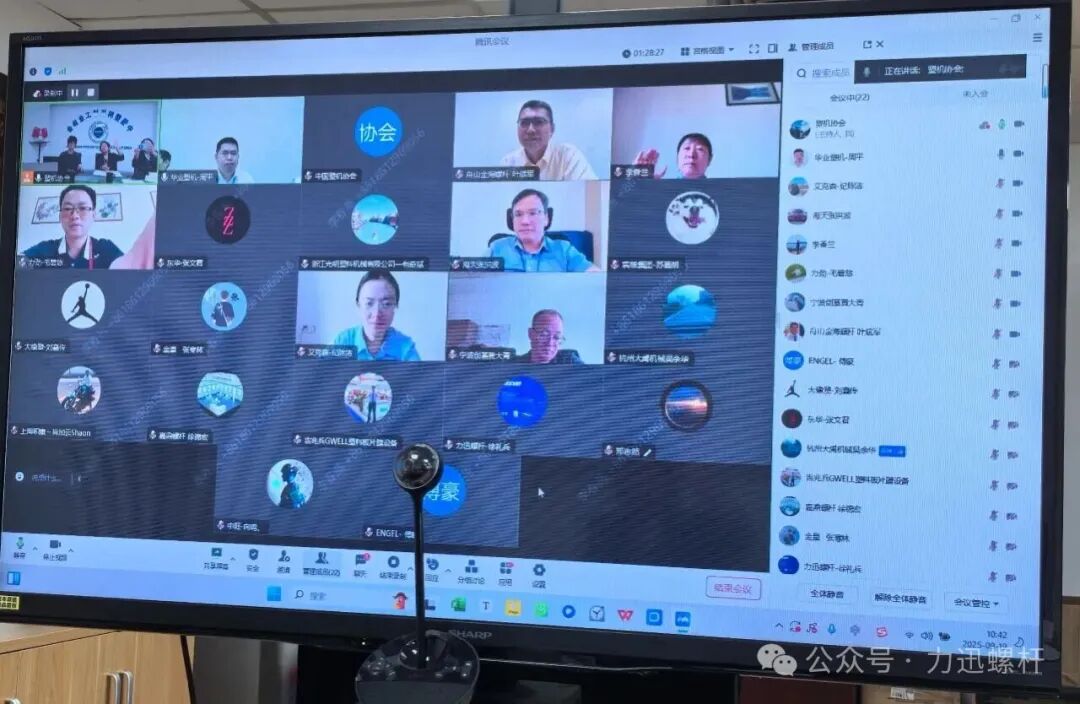
On September 19, 2025, the formulation of the group standard "General Technical Specifications for Screws and Barrels Used in Plastics Machinery", led by the China Plastics Machinery Industry Association (CPMIA), was officially launched via an online kickoff meeting. The meeting brought together leading enterprise representatives and senior experts from plastics machinery manufacturing, core component supply, and research institutions, with the aim of jointly outlining the technological roadmap for key foundational components and laying a solid foundation for upgrading the overall technical level of China's plastics machinery industry. As a well-established brand deeply engaged in the R&D and manufacturing of screws and barrels, Nanjing Lesun Screw Co., Ltd. (hereinafter referred to as "Nanjing Lesun") was invited to participate and contributed forward-looking and practice-oriented core recommendations.
.jpg "/uploads/image/2025/12/17/640 (1).jpg")
At the opening of the meeting, Su Dongping, Executive Vice President of CPMIA and Secretary General of the Group Standards Committee, delivered a keynote address. He emphasized that screws and barrels, as the "heart" of plastics machinery, directly determine the productivity, operational stability, energy efficiency, and even the final product quality of the entire machine. At a time when China's plastics processing industry is undergoing a critical transition toward high-end, intelligent, and green development, establishing a scientific, unified set of technical standards for screws and barrels—aligned with international advanced practices—is of vital strategic importance. Such standards will help regulate the market, remove barriers to industrial collaboration, and enhance the global competitiveness of China's plastics machinery products. The successful convening of this kickoff meeting marked the entry of the standard development process into a substantive drafting and implementation phase.
.jpg "/uploads/image/2025/12/17/640 (2).jpg")
During the highly anticipated technical discussion session, expert representatives from participating companies actively shared insights in a dynamic and constructive atmosphere. Drawing on deep professional expertise and extensive market experience, Xu Libing, General Manager of Nanjing Lesun, put forward systematic and constructive recommendations on the overall framework and technical parameter setting of the standard, focusing on three core dimensions:
Standardization of Raw Materials
Nanjing Lesun proposed that the standard should go beyond basic material grade recommendations and further define precise control ranges for chemical composition, requirements for metallurgical quality (such as cleanliness and homogeneity), and mechanical performance indicators at elevated temperatures. This approach would ensure the reliability, consistency, and service life of core components from the source.
Normalization of Machining Accuracy
The company emphasized that high-precision machining is essential for stable high-speed operation and superior plasticizing quality. The standard should establish clear and stringent classification systems for key geometric parameters—such as screw outer diameter, flight geometry, side clearance—as well as tooth profile accuracy and fit tolerances for internal splines, in order to meet the demanding requirements of diverse high-end applications.
Systematization of Heat Treatment Processes
Nanjing Lesun advocated that the standard should move beyond a single hardness metric and establish a process specification oriented toward comprehensive performance. For critical processes such as nitriding and quenching, in addition to specifying surface hardness and case or hardened layer depth, requirements should also be set for hardness gradients and microstructural characteristics (e.g., martensite grade and grain size). This would ensure optimal wear resistance, toughness, and fatigue performance of components.
.jpg "/uploads/image/2025/12/17/640 (3).jpg")
The successful launch meeting has set a strong foundation for the development of the "General Technical Specifications for Screws and Barrels Used in Plastics Machinery." Xu Libing stated that Nanjing Lesun will continue to participate deeply throughout the subsequent drafting, discussion, and revision stages with a strong sense of industry responsibility. By openly sharing technical expertise and experimental data and working closely with industry peers, the company aims to help bring a technologically advanced, practical, and high-quality standard into effect as soon as possible—contributing Lesun's insight and strength to China's transition from a major plastics machinery manufacturing nation to a true manufacturing powerhouse.