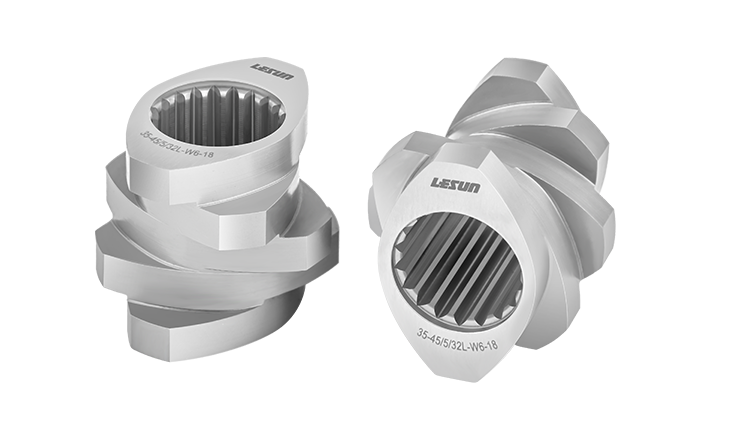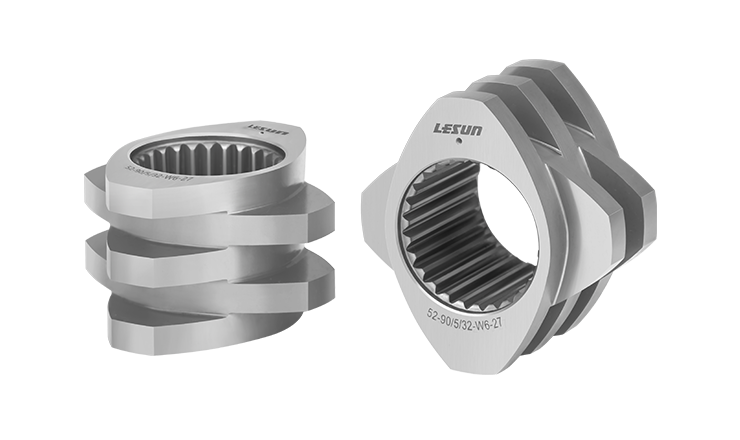
Twin screw extruders are the backbone of modern polymer processing, offering superior mixing, compounding, and conveying capabilities compared to single-screw systems. Whether you are processing engineering plastics, masterbatch, or food-grade compounds, understanding the fundamental differences between co-rotating and counter-rotating twin screw extruder configurations is critical for optimizing your production line. This guide breaks down the key distinctions to help you make an informed equipment decision.
The primary difference between these two systems lies in the direction of screw rotation.
In a co-rotating twin screw extruder, both screws turn in the same direction (either both clockwise or both counterclockwise). This synchronized rotation creates an "∞" (figure-eight) material flow pattern where materials continuously transfer from one screw to the other through the intermeshing zone. The overlapping screw flights generate intense shear forces, making this configuration ideal for applications requiring high-intensity mixing and rapid melting .
Conversely, in a counter-rotating twin screw extruder, the screws rotate in opposite directions. Materials are conveyed forward in discrete, approximately closed "C-shaped" chambers. This positive displacement conveying mechanism resembles a gear pump, offering exceptional stability and reduced backflow. The material experiences gentler shear forces, which is advantageous when processing heat-sensitive or shear-sensitive formulations.
Mixing quality is often the deciding factor when selecting a twin screw extruder.
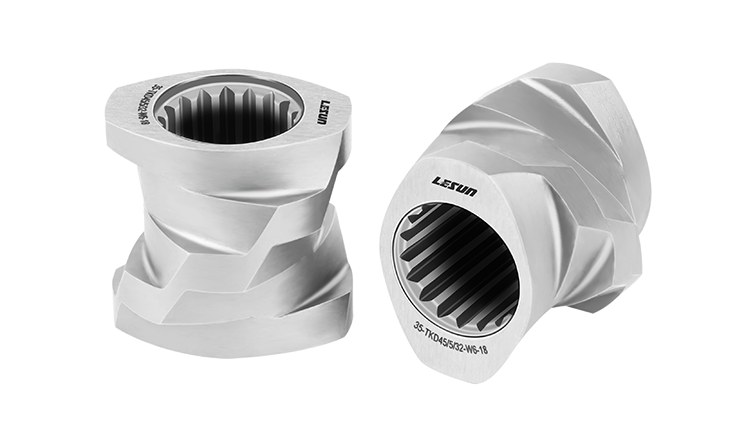
Co-rotating systems excel at distributive mixing — the uniform distribution of additives, fillers, and pigments throughout the polymer matrix. The continuous figure-eight flow ensures that materials undergo repeated splitting, reorientation, and recombination. When equipped with specialized Kneading Screw Elements, co-rotating extruders can achieve exceptional dispersion of nanofillers, carbon nanotubes, and high-concentration masterbatches. The self-wiping action between intermeshing screws also minimizes material stagnation and reduces thermal degradation risks .
Counter-rotating systems, while offering slightly lower distributive mixing uniformity, provide superior dispersive mixing through stronger elongational flow and calendering effects in the intermeshing zone. The localized high pressure generated between counter-rotating screws delivers intense stretching forces that effectively break down agglomerates. However, the confined C-chamber flow limits cross-flow between screws, resulting in broader residence time distributions that can be beneficial for reactive extrusion processes requiring extended reaction times.
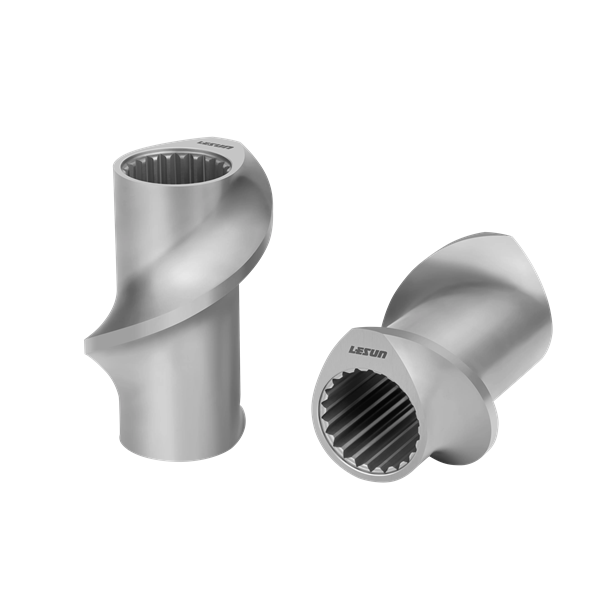
Conveying Screw Elements play fundamentally different roles in each configuration.
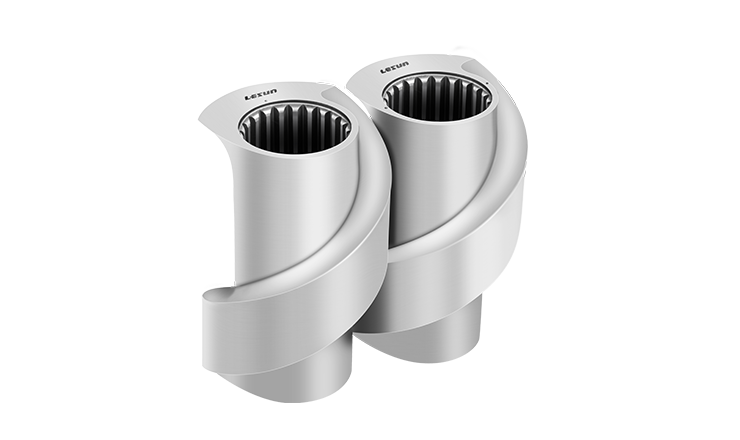
In co-rotating extruders, Conveying Screw Elements with optimized helical flights transport materials along the barrel while simultaneously pushing them into high-shear zones. The conveying efficiency is closely tied to material viscosity — high-viscosity formulations may increase flow resistance and require careful screw design adjustments. These elements typically feature larger pitches in the feeding section to maximize intake capacity, transitioning to smaller pitches in the compression and metering zones to build the necessary die pressure .
Counter-rotating extruders leverage their positive displacement characteristic to achieve more stable conveying volumes that are less affected by material property fluctuations. The tight intermeshing clearance creates a near-sealed transport chamber, enabling higher output rates per screw diameter — often 1.5 to 2 times greater than equivalent co-rotating units for profile extrusion applications. This makes counter-rotating systems particularly cost-effective for PVC pipe, sheet, and profile production where consistent dimensional stability is paramount.
Shear management is crucial for preventing polymer degradation.
Co-rotating twin screw extruders generate high shear rates in the intermeshing zone due to the opposite relative velocities of the screw flights. While this accelerates melting and enhances mixing, it can cause excessive heat buildup in sensitive materials like rigid PVC or certain biopolymers. Modern co-rotating designs mitigate this through modular screw configurations that alternate Kneading Screw Elements with cooling sections, but they generally require more sophisticated temperature control systems.
Counter-rotating extruders operate at lower screw speeds and generate significantly less shear heat. The material spends minimal time in high-shear regions, allowing processing at lower temperatures. This thermal advantage makes counter-rotating systems the industry standard for PVC compounding and extrusion, where preventing thermal degradation is essential for maintaining product color stability and mechanical properties.
Both systems benefit from modular screw designs, but the application differs.
Co-rotating twin screw extruders are renowned for their "building block" screw configuration flexibility. Processors can arrange Conveying Screw Elements, Kneading Screw Elements (available in 30°, 45°, 60°, and 90° disc angles), mixing discs, and reverse elements in virtually unlimited combinations. This modularity allows precise tuning of shear intensity, residence time, and pressure profiles along the barrel — critical for complex compounding tasks, reactive extrusion, and devolatilization operations.
Counter-rotating systems also offer modular options, but the screw geometry is more constrained by the need to maintain tight intermeshing clearances. The focus is typically on optimizing conveying efficiency and pressure generation rather than creating complex mixing sequences. For applications requiring both excellent conveying and moderate mixing, hybrid designs incorporating specialized mixing sections are increasingly available.
Feature | Co-Rotating Twin Screw Extruder | Counter-Rotating Twin Screw Extruder |
Primary Applications | Polymer compounding, masterbatch, nanocomposites, reactive extrusion, pharmaceutical hot-melt extrusion | PVC pipes/profiles/sheets, cable coatings, direct extrusion of rigid/flexible products |
Mixing Type | Superior distributive mixing | Superior dispersive mixing, positive displacement conveying |
Shear Level | High shear, intense kneading | Low to moderate shear, gentle processing |
Residence Time | Short, narrow distribution | Longer, broader distribution |
Pressure Stability | Moderate, rhythmic fluctuations | High, stable pressure build-up |
Energy Efficiency | Higher power for intensive mixing | Lower energy per kg output for profile extrusion |
Best Screw Elements | Kneading Screw Elements for dispersion; Conveying Screw Elements for feed optimization | Conveying Screw Elements optimized for positive displacement |
Choosing between a co-rotating and counter-rotating twin screw extruder depends entirely on your material characteristics and processing objectives. If your priority is intensive mixing, rapid compounding of complex formulations, and maximum operational flexibility, a co-rotating system with strategically placed Kneading Screw Elements and Conveying Screw Elements is the optimal choice. If you require stable conveying, gentle shear conditions, and high-pressure direct extrusion — particularly for PVC or profile applications — a counter-rotating configuration will deliver superior results.
At Lesun, we specialize in precision-engineered screw elements and extrusion solutions tailored to your specific process requirements. Whether you need high-performance Kneading Screw Elements for demanding compounding applications or optimized Conveying Screw Elements for maximum throughput, our engineering team can help you achieve optimal extrusion performance.
Contact us today to discuss your twin screw extruder configuration needs and discover how our modular screw element solutions can enhance your production efficiency.
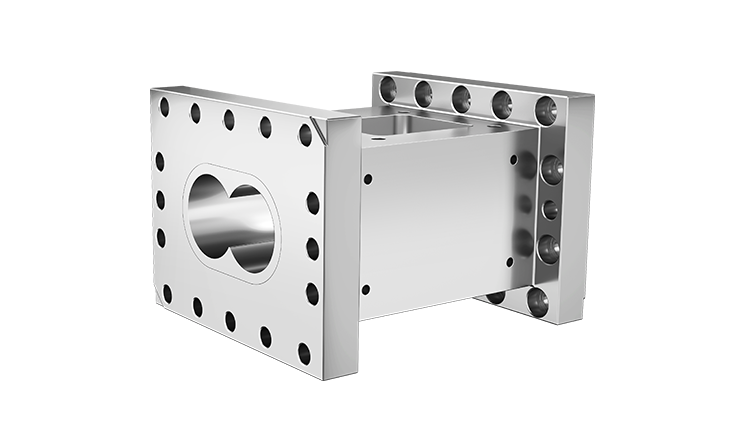
Barrel with vent openings enabling efficient removal of volatiles under controlled partial fill and pressure conditions.
Best suited for:
Devolatilization
Moisture removal
Vacuum venting sections
CKE elements combine conveying and mixing functions, providing gentle material exchange with low shear and reduced energy consumption.
Best suited for:
Heat-sensitive materials
Low-shear compounding processes
Applications requiring stable conveying with mild mixing
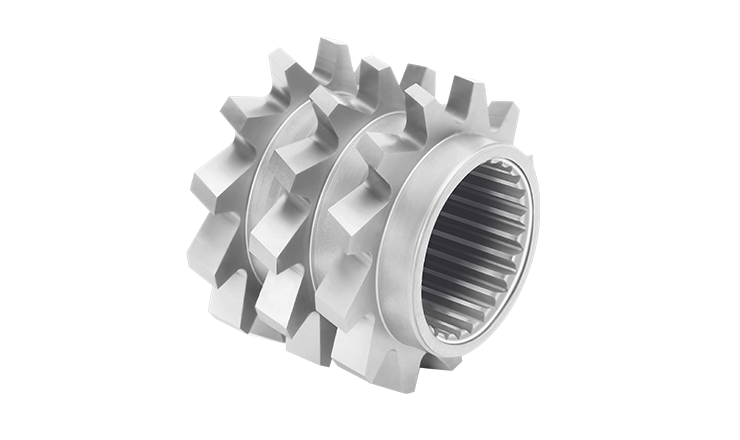
TME elements use intermeshing toothed discs to split and recombine melt flow, achieving efficient distributive mixing without conveying.
Best suited for:
Melt mixing zones
Fiber-reinforced materials
High homogeneity requirements
SSK conveying elements combine the strong conveying ability of single flight elements with increased free volume.
Best suited for:
Difficult-to-feed materials
Low-density powders and fillers
Reverse kneading elements introduce backflow and pressure build-up, increasing residence time and enhancing mixing intensity.
Best suited for:
Before venting zones
Degassing preparation
High mixing demand sections
Neutral kneading elements provide strong mixing with minimal conveying effect, ensuring stable residence time and high mixing efficiency.
Best suited for:
High mixing zones
Sensitive formulations
Residence time control
 Knowledge >
 Product Catalog Download >
 Who are we? >
To make it more convenient for you to obtain product quotations, please check and confirm the following information in the box below.