

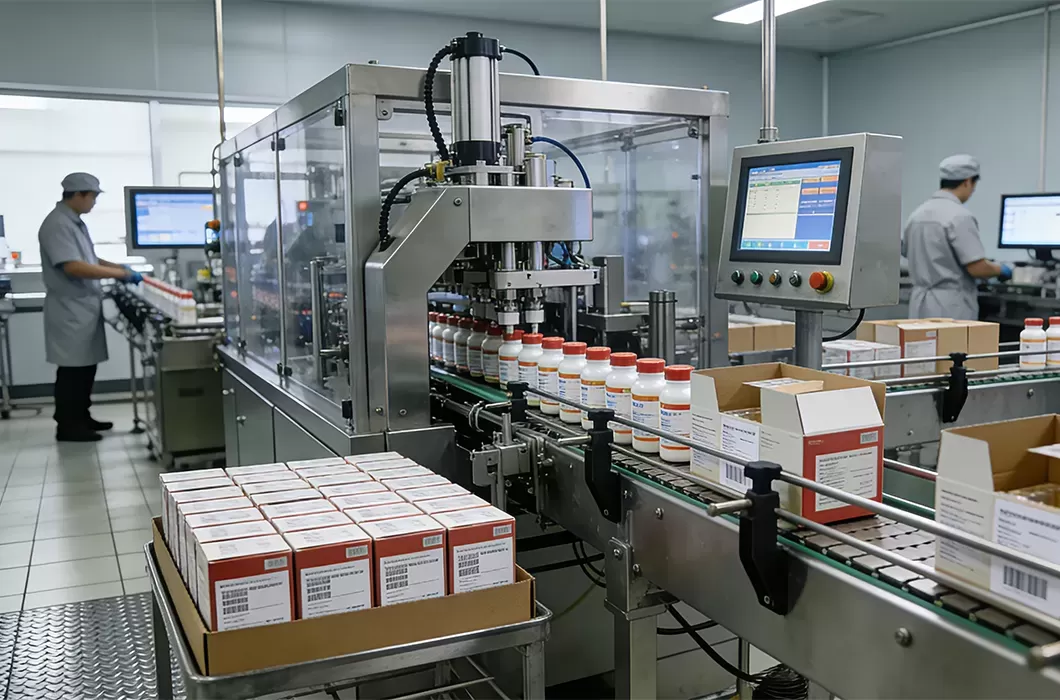
The pharmaceutical industry's core requirements extend far beyond physical mixing, focusing instead on addressing critical pharmaceutical challenges such as drug delivery, dose uniformity, and enhanced stability through precisely controlled continuous processes. Core components must meet the highest standards of pharmaceutical equipment regarding material compliance, process validation, ultra-high cleanliness, and the accuracy and reproducibility of process parameter control.
Process Characteristics: The pharmaceutical and nutraceutical industries impose requirements centered on compliance, precision, and safety on twin-screw extrusion, with standards significantly exceeding those in general industrial applications.The industry must strictly adhere to cGMP guidelines and comply with FDA regulations. The core objective is to achieve precise dosing, gentle processing, efficient dispersion, and absolute contamination control of high-value, and in some cases highly active or poorly soluble pharmaceutical ingredients within continuous production processes. Typical applications include hot-melt extrusion (HME) for solid dispersions, wet granulation, and continuous production of specialized pharmaceuticals such as transdermal patches.
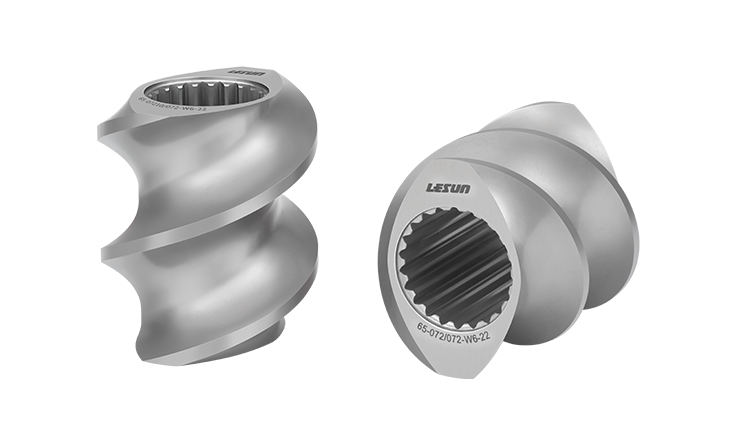
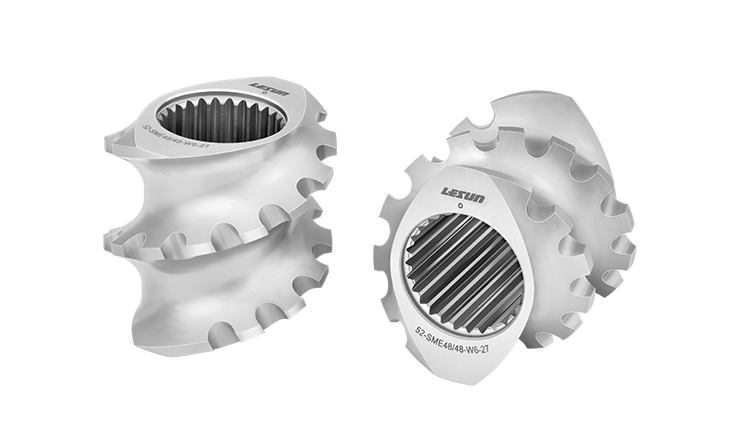
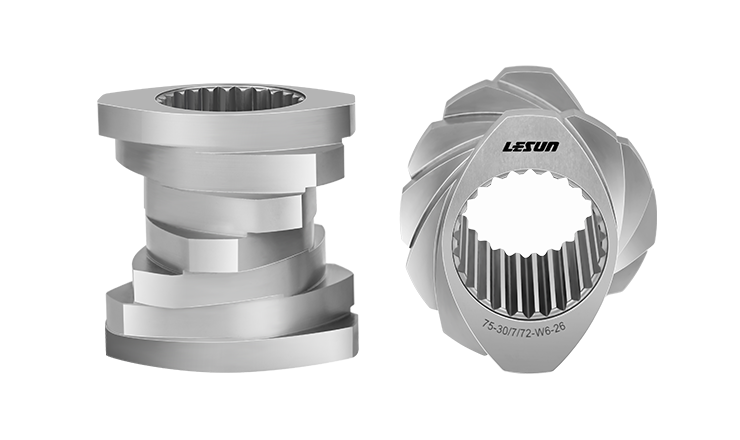
The design of screw elements is critical for ensuring efficient mixing and absolute cleanliness. Their configurations provide excellent distributive and dispersive mixing to uniformly disperse APIs within polymer carriers, thereby enhancing the bioavailability of poorly soluble drugs. Co-rotating self-cleaning screw profiles are mandatory, effectively eliminating material dead zones, preventing cross-contamination, and enabling rapid product changeover. Materials must be pharmacopeia-compliant stainless steel (e.g., 316L), with high-grade polished contact surfaces, typically Ra ≤ 0.8 µm. For certain corrosive or highly abrasive formulations, special alloys or coatings may be required. Modular screw designs allow flexible configuration according to specific formulations to optimize shear and conveying performance.
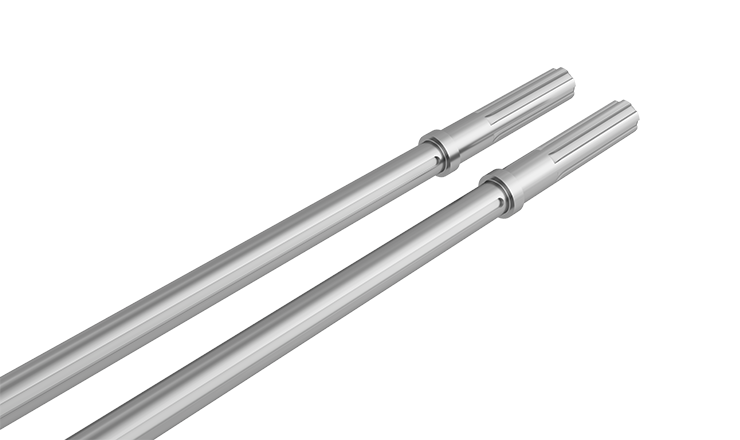
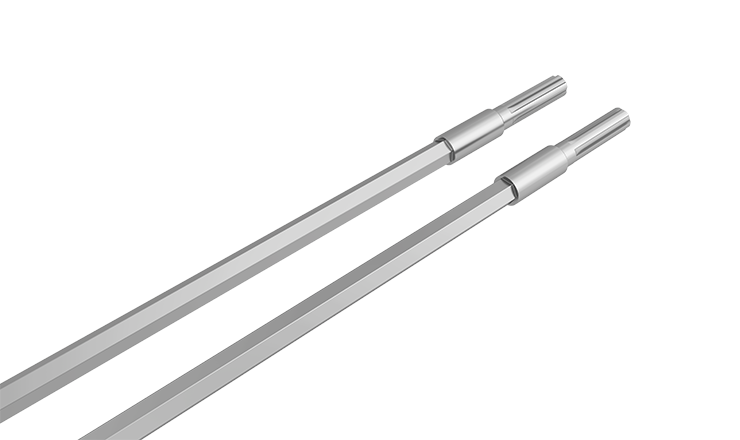
The screw shaft forms the foundation for stable operation in continuous, high-torque processes. To enable gentle processing and prevent API degradation caused by overheating, the extruder operates at high specific torque levels,up to 18 Nm/cm³, which places extreme demands on the torsional rigidity and strength of the screw shaft. High machining accuracy and excellent dynamic balance support screw speeds of up to 1,200 rpm while ensuring smooth, vibration-free operation, which is critical for dosing accuracy and process consistency. Material selection and structural design also provide outstanding fatigue strength and corrosion resistance during long-term operation as well as throughout CIP/SIP cleaning and sterilization procedures.
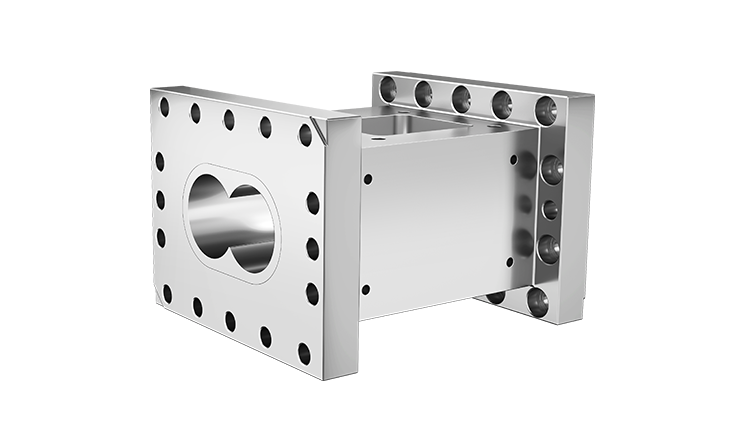
As a closed, GMP-compliant "process reactor," compliant with GMP requirements, the barrel presents the most comprehensive and stringent design criteria. It features a modular design that allows flexible assembly according to process needs—such as multi-point, multi-phase feeding, melting, reaction, and vacuum devolatilization—enabling a customized L/D ratio. All product-contact parts are made of high-grade stainless steel with mirror-polished inner surfaces, designed to be dead-zone-free and fully disassemblable to meet rigorous cleaning and validation requirements. A multi-zone, fast-responding, independent temperature control system is essential for precise process control and protection of heat-sensitive APIs. Additionally, the barrel integrates high-vacuum vent ports to remove moisture and volatiles, enhancing product stability, with design and sealing meeting strict containment standards.

Simple keyed design for basic torque transmission in low-load extrusion systems.
Best suited for:
Low torque applications
Legacy extruders
PVC processing
Double flight conveying elements are the most widely used design in twin screw compounding. They provide the best balance between free volume and torque transmission.
Best suited for:
Feeding sections
Venting zones
Pressure control sections
Barrel with vent openings enabling efficient removal of volatiles under controlled partial fill and pressure conditions.
Best suited for:
Devolatilization
Moisture removal
Vacuum venting sections
SME elements introduce shallow reverse grooves on conveying flights, generating controlled melt backflow and improving distributive mixing.
Best suited for:
Melt stage mixing
General distributive mixing
Applications requiring good self-cleaning
Forward kneading elements provide a balance between conveying and mixing, with adjustable shear depending on stagger angle and disc width.
Best suited for:
Plastication zones
General compounding
Controlled mixing processes
Six-sided geometry enabling uniform torque transfer and rapid screw element replacement.
Best suited for:
Powder coating
Frequent material changes
Fast screw configuration changes

 Knowledge >
 Product Catalog Download >

 Who are we? >
To make it more convenient for you to obtain product quotations, please check and confirm the following information in the box below.