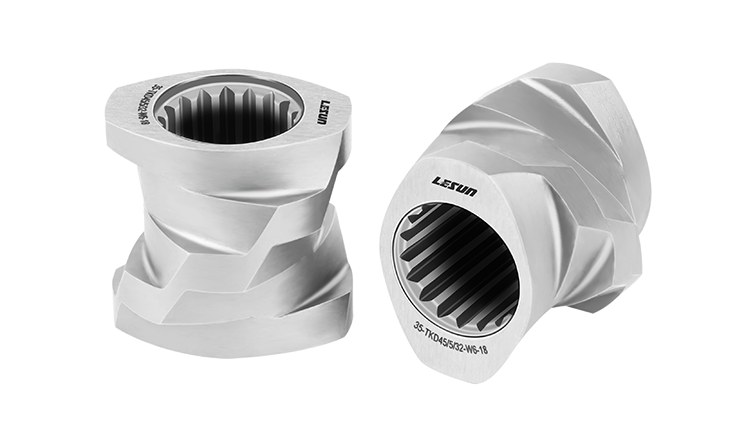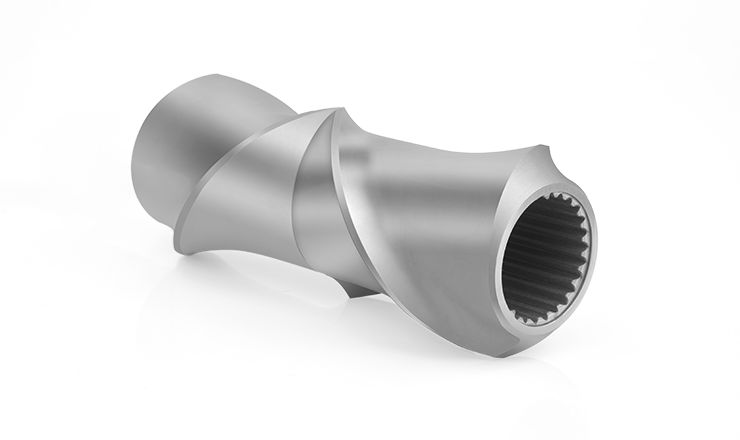


Mixing is one of the primary reasons co-rotating twin-screw extruders dominate modern compounding processes. Whether producing engineering plastics, high-filler compounds, recycled materials, or masterbatches, final product quality depends heavily on how effectively materials are mixed inside the extruder.
However, "good mixing" is often misunderstood. Higher shear does not automatically mean better dispersion, and excessive mixing can sometimes damage polymers, fibers, or additives. Understanding the fundamental mixing mechanisms is therefore essential for designing efficient screw configurations.
In twin-screw extrusion, mixing generally occurs through two distinct mechanisms:
Distributive mixing focuses on repeatedly dividing, rearranging, and recombining material domains throughout the screw channel.
Its purpose is to achieve uniform spatial distribution of:
Additives
Colorants
Stabilizers
Minor components
The material is redistributed without necessarily applying high stress.
Typical distributive mixing elements include:
Forward kneading blocks
Specialized mixing elements
Low-shear distributive mixers
Distributive mixing is particularly important when uniform composition is required while minimizing polymer degradation.
Dispersive mixing is responsible for breaking down agglomerates, clusters, or poorly dispersed particles.
This process requires sufficient stress to overcome the cohesive forces holding particles together.
Typical applications include:
Carbon black masterbatch
Mineral-filled compounds
Flame-retardant systems
Pigment concentrates
Dispersive mixing is generated primarily through:
Kneading blocks
High-shear mixing elements
Narrow flow passages
Pressure-induced deformation zones
The objective is not merely to move material but to physically reduce particle size and improve dispersion quality.
Unlike single-screw systems, twin-screw extruders continuously generate complex flow patterns through the interaction of screw flights and intermeshing channels.
Several flow mechanisms contribute simultaneously:
Material repeatedly divides and rejoins as it moves through intermeshing screw sections.
This mechanism creates efficient distributive mixing without excessive shear.
As material passes through constricted regions between screw elements, it experiences stretching and deformation.
Extensional flow is often more effective than simple shear for breaking agglomerates.
Velocity differences within the melt generate shear stresses that assist particle dispersion and homogenization.
Properly controlled shear improves mixing performance, while excessive shear can increase wear and polymer degradation.
Effective mixing requires sufficient exposure time.
A well-designed screw configuration balances throughput with residence time to ensure adequate mixing without over-processing the material.
Mixing performance is determined less by machine size and more by screw design.
A properly engineered configuration controls:
Material conveying
Melting behavior
Pressure development
Shear intensity
Residence time
Dispersion efficiency
For example:
Glass fiber compounds typically require controlled distributive mixing to preserve fiber length.
High-filler compounds often require stronger dispersive mixing to break particle agglomerates.
Recycled plastics frequently need a combination of dispersive mixing, devolatilization, and homogenization.
The optimal solution depends on the specific material system rather than a universal screw design.
In industrial compounding, mixing efficiency should always be evaluated together with:
Specific energy consumption
Throughput stability
Wear rate
Melt temperature
Product consistency
Aggressive mixing sections may improve dispersion but can also accelerate screw wear, increase melt temperature, and reduce equipment life.
The most successful screw configurations achieve the required mixing quality with the lowest possible mechanical and thermal load.
Mixing in twin-screw extrusion is the result of multiple interacting mechanisms, including distributive mixing, dispersive mixing, extensional flow, and controlled residence time.
Understanding these mechanisms allows engineers to design screw configurations that achieve the desired balance between dispersion quality, process stability, energy efficiency, and equipment durability.
Ultimately, effective compounding is not about maximizing shear—it is about applying the right mixing mechanism at the right location within the extrusion process.
WhatsApp: 8613605142173
Mail: sales@lesunscrew.com
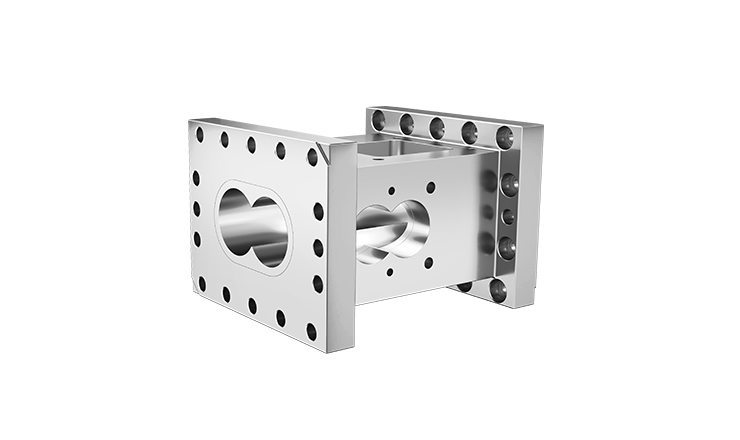
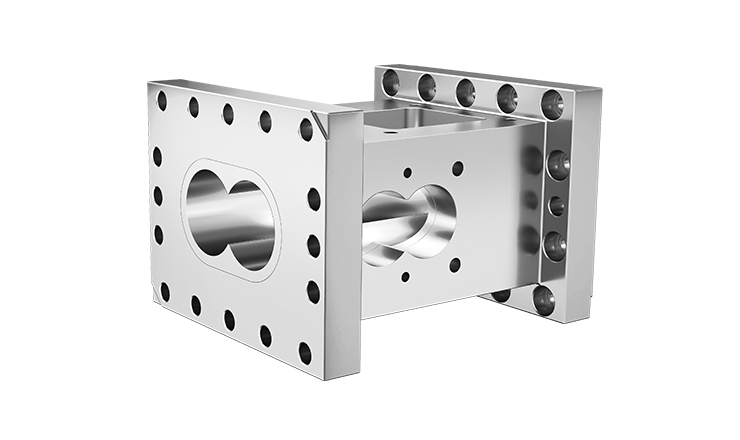
Barrel with side feeding port for controlled addition of fillers, fibers or additives during processing.
Best suited for:
Fiber reinforcement
Filler addition
Multi-component compounding
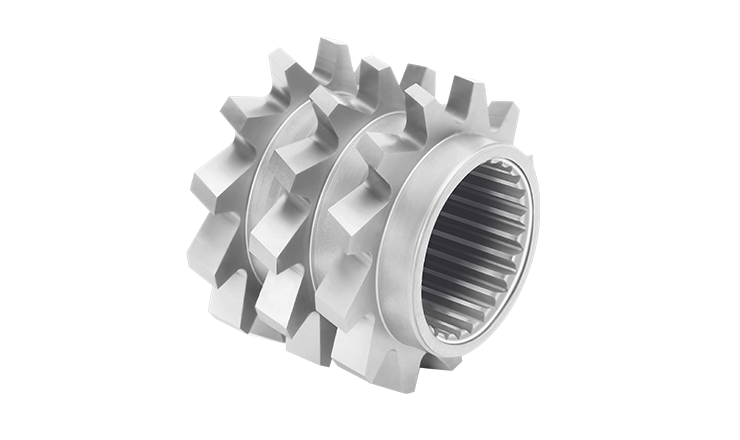
TME elements use intermeshing toothed discs to split and recombine melt flow, achieving efficient distributive mixing without conveying.
Best suited for:
Melt mixing zones
Fiber-reinforced materials
High homogeneity requirements
Integrated barrel combining feeding and venting functions to optimize space and enhance process flexibility.
Best suited for:
Compact configurations
Combined feeding and venting
Flexible process layouts
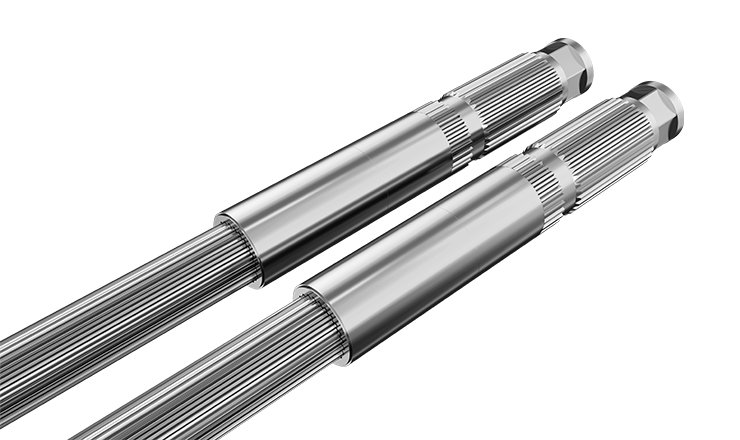
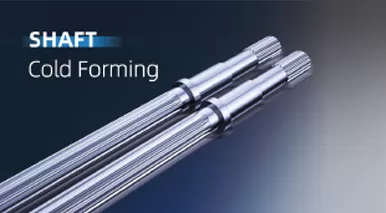
Cold-Forming high-torque shaft with improved strength and fatigue resistance for demanding extrusion conditions.
Best suited for:
High torque extrusion systems
High filler compounding
Continuous high-load production
CKE elements combine conveying and mixing functions, providing gentle material exchange with low shear and reduced energy consumption.
Best suited for:
Heat-sensitive materials
Low-shear compounding processes
Applications requiring stable conveying with mild mixing
Stretching elements, also called S-type elements, improve material exchange and distributive mixing in partially melted zones.
Best suited for:
Semi-plasticized material zones
Improved dispersion
Gentle mixing processes

 Knowledge >
 Product Catalog Download >
 Who are we? >
To make it more convenient for you to obtain product quotations, please check and confirm the following information in the box below.