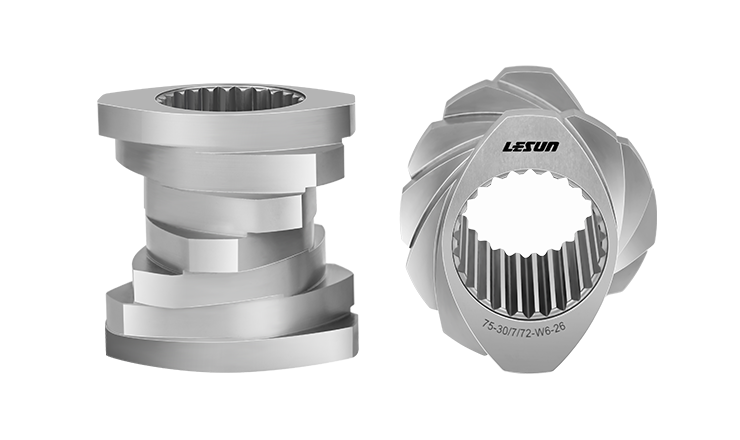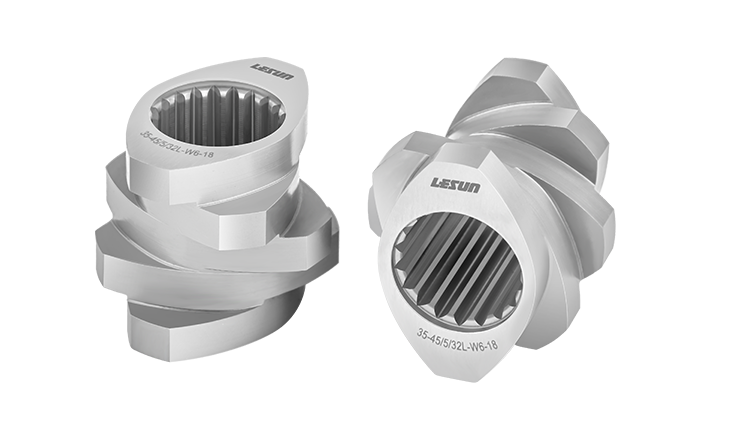


As twin-screw compounding extruders evolve toward higher torque, greater wear resistance, and severe corrosive environments, component failure is no longer merely a matter of surface wear. Instead, it represents a complex confluence of mechanical fatigue and catastrophic fracture under extreme operational stress. To balance maximum throughput with long-term reliability, Nanjing Lesun Screw moves beyond empirical alloy selection. Instead, we execute structural design and application matching based strictly on quantitative tensile and impact mechanical properties.
In a co-rotating twin-screw extruder, the shaft and screw elements encounter distinctly different static and alternating stress profiles. Rather than focusing on the deformation mechanics during a standard tensile test, our engineering team directly extracts two critical metrics to define the components' elastic and plastic boundaries: Yield Strength (σ0.2) and Ultimate Tensile Strength (σb).
When driving screw configurations at high torque densities ranging from 11~15Nm/cm3 or above, the outer diameter of the spline shaft experiences extreme shear stress. According to the Maximum Shear Stress Theory (Tresca Yield Criterion), the shear yield strength of an alloy is defined as:
Ƭs≈0.5~0.577σs
If the selected spline shaft material possesses insufficient yield strength (σ0.2), the shaft will undergo irreversible plastic torsional deformation when subjected to cold-start torque or instantaneous feed fluctuations. This deformation leads to permanent shaft twisting, making it impossible to assemble or disassemble the screw elements. Consequently, Lesun uses (σ0.2) as a rigid safety threshold, ensuring that the maximum shear stress under peak load never exceeds 60% of Ƭs.
Within the intense shear zones of co-rotating twin-screw extruders, polymer melts are forced through the tight radial clearances of kneading blocks. This process exerts massive, localized hydrodynamic back pressure on the root of the screw elements.
The ultimate tensile strength (σb) dictates whether the metal substrate can suppress micro-void formation and dislocation slip under long-cycle alternating fatigue stresses. High tensile strength effectively inhibits the initiation of micro-cracks, preventing root fracture or wing breakage during high-pressure shear compounding.
In compounding applications involving high volume fractions of rigid fillers—such as 50% glass fiber (GF), carbon fiber, titanium dioxide, or ceramic powders—the failure mode of screw elements shifts from gradual wear to instantaneous brittle fracture or chipping along kneading block edges. This behavior is governed directly by the material's Charpy V-notch impact energy (KV).
During extrusion runs, unmelted pellets, highly carbonized polymer agglomerates, or tramp metal fragments can exert dynamic shock loads on the screw elements within microseconds. In these brief intervals, the material cannot absorb energy via plastic deformation; it must rely entirely on its grain boundaries and matrix to dissipate kinetic energy.
If the material's Charpy V-notch impact energy is too low, cracks propagate at the speed of sound through the primary carbide network, causing catastrophic shattering of the element. By optimizing advanced heat treatment processes, Lesun ensures that high-hardness steels maintain a reliable balance between extreme yield strength and sufficient dynamic energy absorption capacity.
During cold-start sequences where the barrels are insufficiently preheated or internal polymers remain solidified, the startup torque can spike to several times the rated value. Concurrently, a steep temperature gradient develops between the outer surface of the element and the inner core shaft, generating significant residual thermal stresses.
Impact energy—specifically the material's resistance to brittle fracture under multiaxial constraint—is the decisive metric that determines whether high-stress concentration areas (such as the tip radius or the staggered edges of kneading blocks) will chip or delaminate under these combined thermal and mechanical loads. (Note: While plane-strain fracture toughness KIC is related, it is a separate property measured under different conditions; here the Charpy V-notch energy remains the practical engineering indicator for chipping resistance.)
To provide global procurement and engineering teams with transparent physical baselines, Nanjing Lesun presents the laboratory-tested tensile and impact data in the simplified matrix below:
Steel Grade / Material | Typical Hardness (HRC) | Yield Strength σ0.2(MPa) | Tensile Strength σb(MPa) | Impact Energy Ak (J, Charpy V-Notch) |
38CrMoAlA (Nitridable Steel) | Core: 28-32 Nitrided Layer: ≥950HV | ~ 835 | ~980 | ~40 (Core Matrix) |
6542 (High-Speed Tool Steel) | 61 - 64 | ~2100 | ~2400 | ~15 - 18 |
PM Steel (e.g., WR5 / CPM 10V) | 62 - 66 | ~2400 | ~2700 | ~22 - 26 |
Lesun Spline Shaft Steel (Advanced Alloy Hot-Work Steel) | 48 - 52 | ~1450 | ~1650 | ~65 |
Deep Analysis of Material Mechanical Profiles and Application Matching:
38CrMoAlA (Nitridable Steel) — General Filling & Low-Wear Applications
The core matrix of this material exhibits excellent ductility and toughness (with impact energy up to 40J). However, its fatal limitation lies in its severe mechanical gradient. The shallow nitrided case (only 0.2–0.5 mm thick) is inherently brittle. Under actual compounding conditions, when subjected to high hydrodynamic pressure or minor foreign object impacts, micro-cracks readily nucleate within the nitrided layer and propagate rapidly into the core, causing surface delamination or fatigue spalling. With an ultimate tensile strength below 1000 MPa, it cannot withstand high torque densities and is strictly limited to non-abrasive, non-corrosive, general-purpose filler compounding (e.g., CaCO₃/talc masterbatches).
6542 (High-Speed Tool Steel) — Engineering Plastics & High-ROI Compounding
Armed with an exceptional yield strength exceeding 2000 MPa, 6542 steel represents the definitive cost-to-performance choice for mid-tier markets. Although its impact energy (15~18J) is lower than that of conventional structural alloys, its elevated yield threshold effectively prevents the component from entering plastic deformation zones under standard radial and axial shear stresses. The monolithic hardness profile and uniformly distributed carbides ensure that its chipping resistance significantly outperforms conventional cold-work tool steels. It perfectly matches compounding processes involving moderate glass fiber loading (≤30%) and standard engineering plastics such as PA6, PA66, and PBT.
Premium Powder Metallurgy Steel (e.g., WR5 / CPM 10V) — Ultra-High Torque, Extreme Wear & Severe Corrosive Environments
The core value of Powder Metallurgy (PM) processing lies in its ability to break the traditional negative correlation between hardness and impact energy. Using gas atomization and Hot Isostatic Pressing (HIP), PM steel completely eliminates primary carbide segregation, yielding an ultra-fine, isotropic grain structure. This allows the alloy to achieve a monumental tensile strength of 2700 MPa while maintaining a high impact energy of ≥22J, even at hardness levels exceeding 63 HRC. The highly dispersed micro-carbides force propagating cracks to navigate countless grain boundary impediments, effectively eliminating unexpected edge chipping or kneading block fracture. It serves as the standard baseline for extreme processing environments, including >50% glass fiber reinforcement and Halogen-Free Flame Retardant (HFFR) compounding.
Lesun Spline Shaft Steel — Ultimate Torsional Resistance & High-Density Drive Trains
In spline shaft architecture, the engineering goal is maximizing the toughness–strength product: the combination of yield strength and impact energy. This customized steel trades away superficial wear resistance for a superb impact energy of 65 J, while retaining a robust yield strength of 1450 MPa at its core. This ensures that when transmitting extreme torque densities (11~15 Nm/cm³ and above), the shaft can absorb instantaneous shear overloads (such as during cold starts) via elastic lattice strain without experiencing sudden brittle torsional fracture or catastrophic failure. It is purpose-built for high-output, high-density drive train architectures.
In the precision manufacturing of twin-screw extruder components, there is no single "universal alloy." Maximum operational life is achieved only by matching the tensile properties, yield thresholds, and impact energy of a material with the unique rheological and chemical traits of the processed polymer.
The comprehensive mechanical database established by Nanjing Lesun Screw allows our team to tailor configurations based precisely on your extruder's torque class, filler ratios, and chemical corrosiveness. Discover how we optimize component lifecycles through our tailored Lesun Screw Material Selection Solutions. By executing rigorous tensile and impact lot testing on every batch of raw steel, we ensure that every component delivered to our global partners is engineered to withstand extreme industrial stress.
WhatsApp: 8613605142173
Mail: sales@lesunscrew.com
Stretching elements, also called S-type elements, improve material exchange and distributive mixing in partially melted zones.
Best suited for:
Semi-plasticized material zones
Improved dispersion
Gentle mixing processes
SK conveying elements provide approximately 15% higher free volume than standard conveying elements and are particularly suitable for low bulk density materials.
Best suited for:
Feeding zones
Side feeding
Low bulk density materials
ZME elements combine reverse conveying structure with forward teeth, creating intensive cutting and recombination of melt flow.
Best suited for:
High mixing intensity applications
Difficult-to-disperse materials
High-performance compounding
Liquid Injection Barrel | Twin Screw Extruder Dosing Barrel
Forward kneading elements provide a balance between conveying and mixing, with adjustable shear depending on stagger angle and disc width.
Best suited for:
Plastication zones
General compounding
Controlled mixing processes
Reverse kneading elements introduce backflow and pressure build-up, increasing residence time and enhancing mixing intensity.
Best suited for:
Before venting zones
Degassing preparation
High mixing demand sections

 Knowledge >
 Product Catalog Download >
 Who are we? >
To make it more convenient for you to obtain product quotations, please check and confirm the following information in the box below.