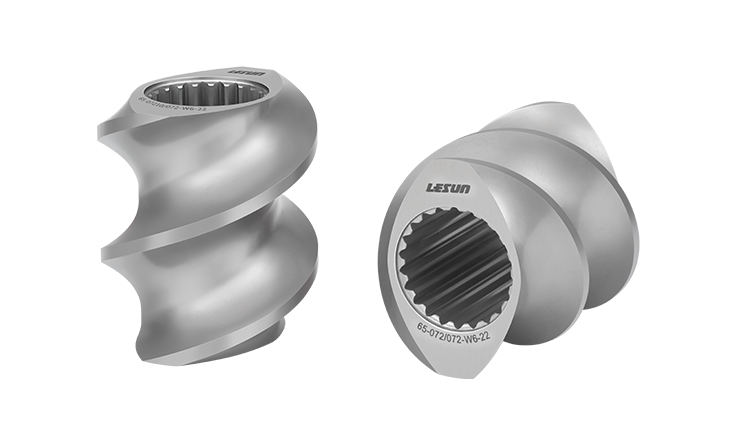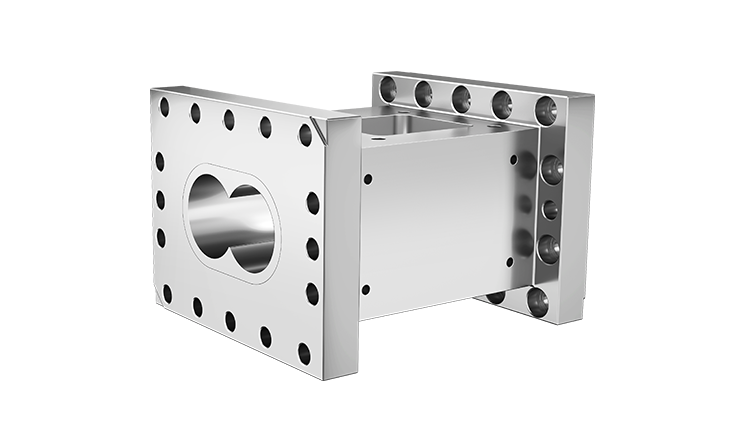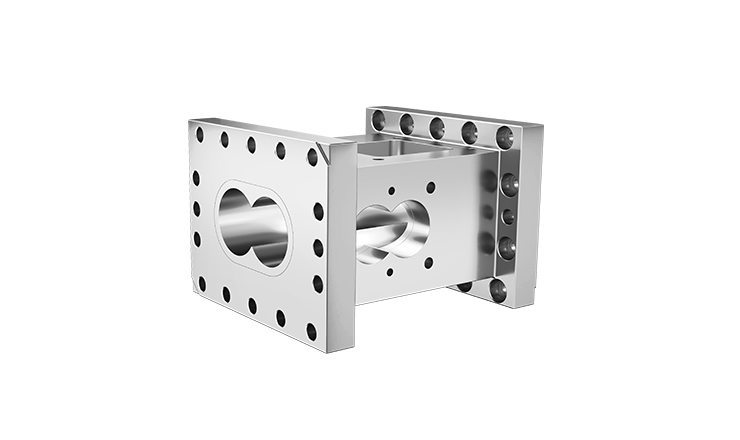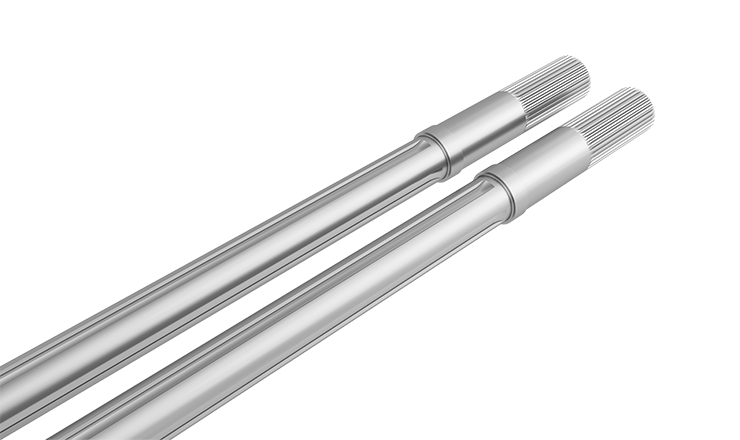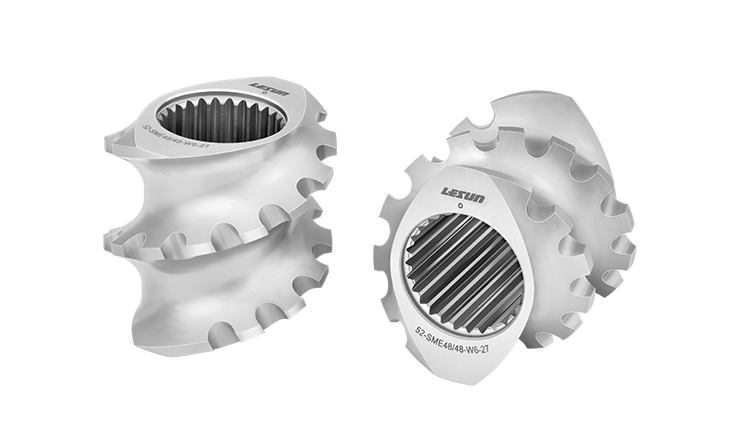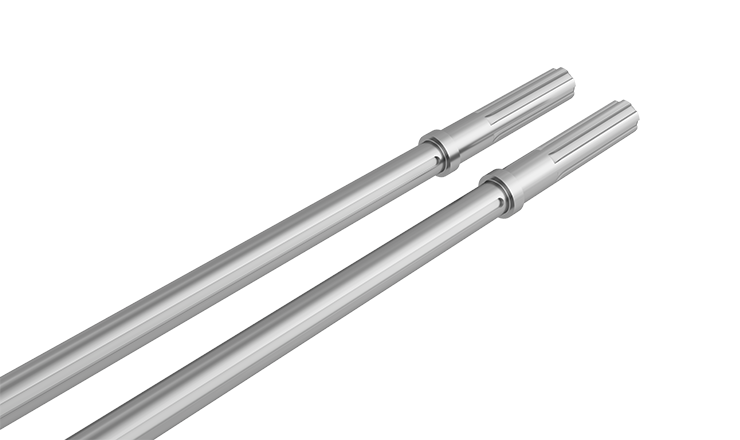


When original spare parts are costly, lead times are extended, equipment is obsolete, or an existing supply channel cannot support the maintenance schedule, end users often look for OEM-compatible replacement components. A reliable replacement must do more than fit the machine. It must also match the existing screw system, shaft interface, barrel structure, and operating conditions. Lesun Screw supports compatibility assessment, reverse engineering, and custom manufacturing for twin-screw extruder screw elements, screw shafts, barrels, and liners.
Compatible replacement solutions are relevant to routine maintenance, localized wear replacement, legacy equipment maintenance, and second-source development. A customer may not need to replace a complete screw or barrel assembly. Depending on the wear location and machine condition, the required scope may be an individual screw element, a partial screw section, a shaft, a barrel section, or a liner. When the original part has a clear wear or corrosion issue, an alternative material can also be evaluated while preserving the required machine interfaces and assembly relationships.
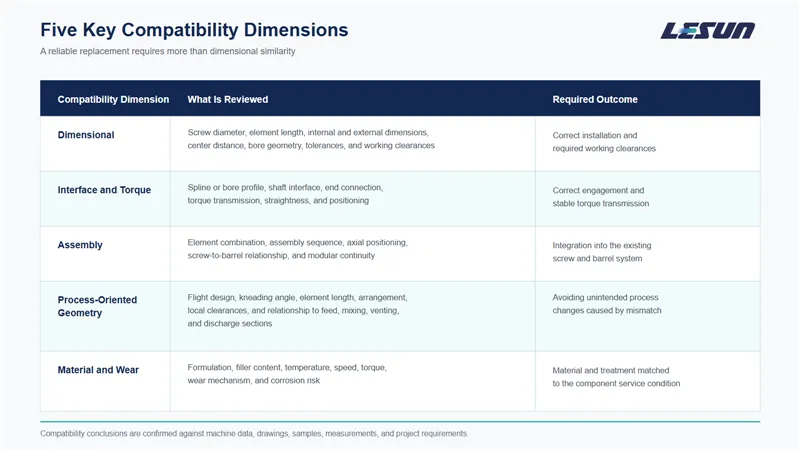
Dimensional compatibility covers screw diameter, element length, internal and external dimensions, barrel bore geometry, center distance, assembly references, and critical clearances. In a twin-screw extruder, dimensional deviations can affect more than installation. They may also change the working relationship between the screws and between the screws and the barrel. Replacement designs are therefore normally based on the machine model, original drawings, component samples, or measured data.
Screw elements must engage correctly with the shaft spline or bore, while the shaft must meet the requirements for torque transmission, end connections, straightness, and assembly positioning. Lesun can evaluate single-key, rectangular, hexagonal, and involute spline arrangements and confirm the interface against the machine and drawing requirements. The final spline form, dimensions, and torque requirements remain project-specific.
Assembly compatibility concerns the relationship between individual elements, the fit between elements and the shaft, assembly direction, axial positioning, and the working clearance between the screw and barrel. The replacement must integrate into the existing modular system rather than merely resemble the original part in isolated dimensions.
The geometry, flight design, kneading-block angle, element length, arrangement, and local clearances of a replacement can affect conveying, melting, distributive mixing, dispersive mixing, filling, degassing, pressure build-up, and residence time within the screw system. A compatibility assessment must therefore review how the replacement relates to the existing screw configuration and barrel working sections, in addition to confirming installation. Lesun focuses on avoiding unintended process changes caused by geometric mismatch and does not promise a specific production result without sufficient process information.
Material selection should consider the processed formulation, filler content, operating temperature, screw speed, torque, corrosiveness, and dominant wear mechanism. Screw elements, shafts, barrels, and liners do not experience identical loading or wear conditions, so the same material should not automatically be applied to every component.
Based on the machine model, screw diameter, screw layout, samples, or drawings, Lesun can manufacture twin-screw extruder conveying elements, kneading blocks, mixing elements, transition elements, and reverse elements. The screw element range covers Ø18–400 mm and supports multi-variant, small-batch, and production-volume requirements.
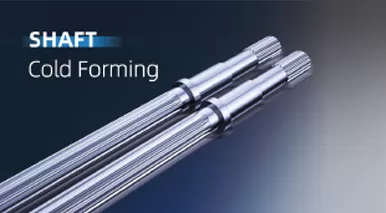
The screw shaft supports the screw elements and transmits torque through the assembly. Lesun can manufacture and customize shafts in the Ø10–200 mm range, with single-key, rectangular, hexagonal, and involute spline options. Shaft length, coupling method, material, and torque grade must be confirmed against the machine and interface information.
Barrel replacement can focus on specific sections such as the feed, side-feed, mixing, venting, liquid-injection, or discharge section. Lesun supports barrel-section designs from 1D to 12D and can evaluate integral barrels, split barrels, replaceable liners, and wear- or corrosion-resistant options according to the structure and operating conditions. Connection methods, heating and cooling, ports, bore geometry, and sealing requirements are also reviewed.
Depending on the component and application, material options include nitriding steel, cold-work tool steel, high-speed tool steel, powder metallurgy steels, alloy structural steel, hot-work tool steel, stainless steel, Hastelloy C-series alloy, carbon structural steel, and nickel-bonded tungsten carbide. Available routes include surface hardening, through hardening, HIP, solution treatment, laser cladding, and sintering as specified for the relevant material option. The final material and treatment should be confirmed through engineering review of the process, wear or corrosion condition, and component function.
Complete drawings can make confirmation more efficient, but they are not a prerequisite for starting a project. Customers can begin with the machine brand and model, screw diameter, L/D, component photographs, part numbers, worn samples, or available measurements. Lesun’s engineering team combines this information to identify the machine and component and, when required, uses sample measurement, interface verification, wear-condition review, and reverse engineering to establish the technical basis for design, manufacturing, and inspection.
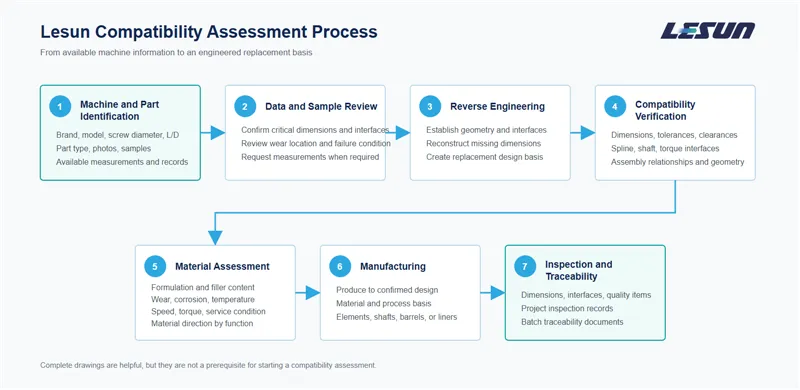
Lesun’s engineering process normally starts with machine and component identification, followed by verification of geometry, interfaces, and assembly relationships. Material options are then evaluated according to the component function and processing conditions. After design confirmation, the part proceeds through manufacturing, inspection, and quality traceability. For legacy machines with incomplete documentation, the engineering team progressively establishes the key technical information from available samples, photographs, measurements, and machine data.
When the objective is to restore production quickly while maintaining the existing machine relationships, a like-for-like replacement can preserve the original dimensions, interfaces, and structure as far as the available information allows. For glass-fiber compounds, mineral-filled formulations, recycled materials, or corrosive formulations, a more suitable wear- or corrosion-resistant material can be evaluated when the original part has a clear failure pattern. This material selection is an engineering assessment based on the component’s service condition and does not constitute a guarantee of the final process result.
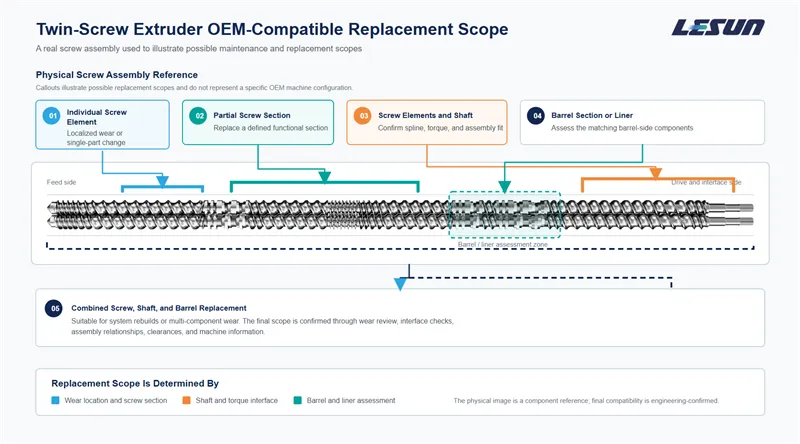
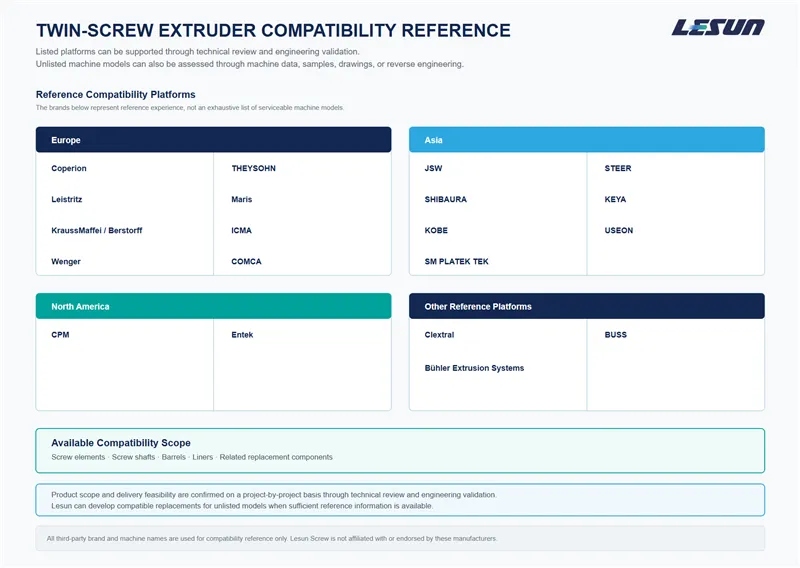
Lesun has established compatibility references for multiple extruder brands, including Coperion, Leistritz, KraussMaffei / Berstorff, THEYSOHN, Maris, ICMA, Wenger, COMCA, JSW, SHIBAURA, KOBE, STEER, KEYA, USEON, SM PLATEK TEK, CPM, Entek, Clextral, Bühler Extrusion Systems, and BUSS. This list represents existing reference experience and is not a complete list of serviceable machine models.
If a customer’s machine brand or model is not listed, Lesun can still evaluate the project when machine information, samples, photographs, measurements, or other reference data are available. A compatible replacement can then be developed through reverse engineering.
Before delivery, replacement parts can be checked for dimensions, interfaces, spline fit, hardness, or heat-treatment condition according to project requirements. Relevant quality records and batch traceability documents can also be prepared. Lesun’s quality management and documentation system is used to meet the quality management and audit requirements of multiple international companies. The specific inspection items and report format depend on the confirmed technical documents and project requirements.
Customers can begin by submitting the machine brand and model, screw diameter, L/D, component to be replaced, photographs or samples, processed material, and main wear issue. Complete drawings are not required to start. Lesun’s engineering team can review the available information, identify what needs to be confirmed, and define the next steps for measurement, reverse engineering, material assessment, and manufacturing.
An OEM-compatible replacement part is developed to match the specified machine, interfaces, dimensions, and application conditions. It is not an original OEM-manufactured part and does not imply OEM authorization. Final compatibility is confirmed against the available machine data, sample, drawing, or measurement results.
Yes. Lesun can use machine information, samples, photographs, measurements, and wear conditions for engineering assessment and, when required, establish the manufacturing basis through reverse engineering.
Yes. Partial replacement can be considered, but its suitability must be confirmed against the wear location, assembly relationships, interfaces, clearances, and existing screw configuration.
Material selection is evaluated against the processed formulation, filler content, temperature, speed, torque, and actual wear or corrosion condition. Customers can begin by providing the application and failure information so the engineering team can identify the material factors that require confirmation.
Lesun can review the existing screw layout and provide compatibility-oriented technical comments when necessary. This is not the primary service and does not constitute a guarantee of the final process result.
To start a project, send the machine brand and model together with any available photographs, samples, dimensions, or component information. Lesun will review the available information, identify whether additional data is required, and then arrange the compatibility assessment, reverse engineering, and subsequent manufacturing confirmation.
Double flight conveying elements are the most widely used design in twin screw compounding. They provide the best balance between free volume and torque transmission.
Best suited for:
Feeding sections
Venting zones
Pressure control sections
Barrel with vent openings enabling efficient removal of volatiles under controlled partial fill and pressure conditions.
Best suited for:
Devolatilization
Moisture removal
Vacuum venting sections
Barrel with side feeding port for controlled addition of fillers, fibers or additives during processing.
Best suited for:
Fiber reinforcement
Filler addition
Multi-component compounding
Robust rectangular spline design providing stable torque transmission with moderate load capacity.
Best suited for:
Medium torque systems
Chemical processing
Replacement applications
SME elements introduce shallow reverse grooves on conveying flights, generating controlled melt backflow and improving distributive mixing.
Best suited for:
Melt stage mixing
General distributive mixing
Applications requiring good self-cleaning
Simple keyed design for basic torque transmission in low-load extrusion systems.
Best suited for:
Low torque applications
Legacy extruders
PVC processing

 Knowledge >
 Product Catalog Download >
 Who are we? >
To make it more convenient for you to obtain product quotations, please check and confirm the following information in the box below.