

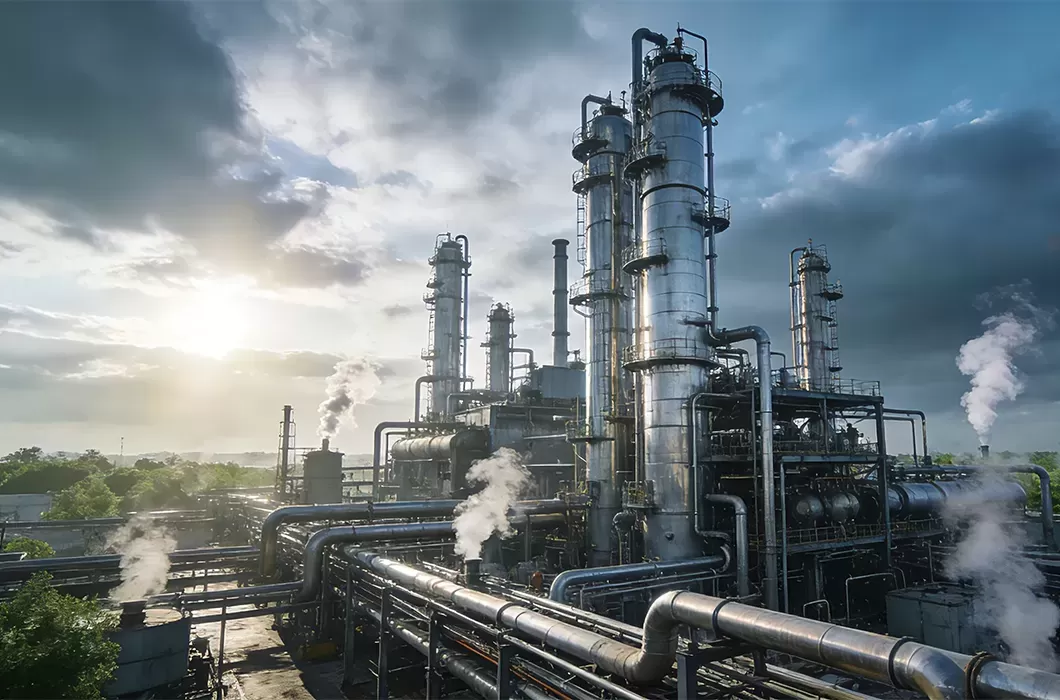
The chemical and powder coatings sectors represent a high-end application market for twin-screw extrusion technology. The core requirement is not merely high output or wear resistance, but achieving controlled, stable, clean, and efficient mixing, reaction, and devolatilization under complex chemical environments and precise process conditions. This necessitates customized solutions that integrate corrosion-resistant specialty materials, mechanical designs capable of withstanding extreme loads, and fully integrated process modules.
Process Characteristics: The chemical and powder coatings industries impose multidimensional and stringent requirements on twin-screw extrusion processes. These include handling materials across a wide viscosity range, processing highly corrosive or abrasive materials, achieving precise control over chemical reactions, and meeting strict purity and safety standards. This requires core components with specialized performance exceeding that of standard designs. Typical applications include reactive extrusion, powder coatings, hot-melt adhesives, battery materials such as electrode slurries, and additive synthesis.
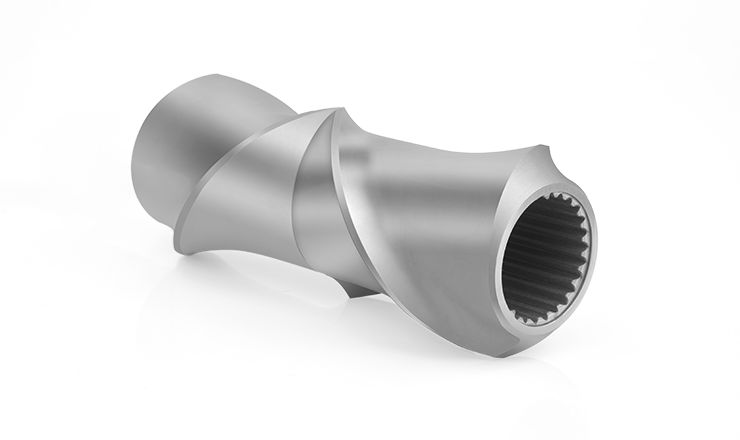
Screw elements play a decisive role in enabling twin-screw extruders to process complex formulations. Their geometry must deliver excellent distributive and dispersive mixing to ensure uniform distribution of all components, including nanoparticles. When processing highly corrosive material such as acids or catalysts, specialty alloys or corrosion-resistant coatings are essential. For low-bulk-density, hard-to-feed materials like powders or fumed silica, optimized screw designs ensure stable conveying. In addition, self-cleaning geometries and easy-to-clean surface finishes support flexible and efficient formulation changeover.
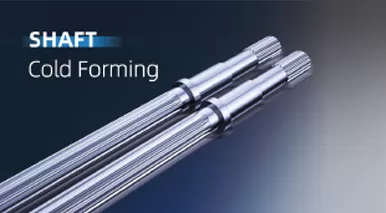
The screw shaft withstands the extreme torque and axial loads generated by high-viscosity materials and extended reaction processes, with L/D ratios reaching up to 68. It offers top-level structural rigidity and fatigue strength. In applications involving precise chemical reactions or heat-sensitive materials, high precision machining and excellent dynamic balance of the shaft are critical to maintaining stable process conditions and preventing localized overheating.
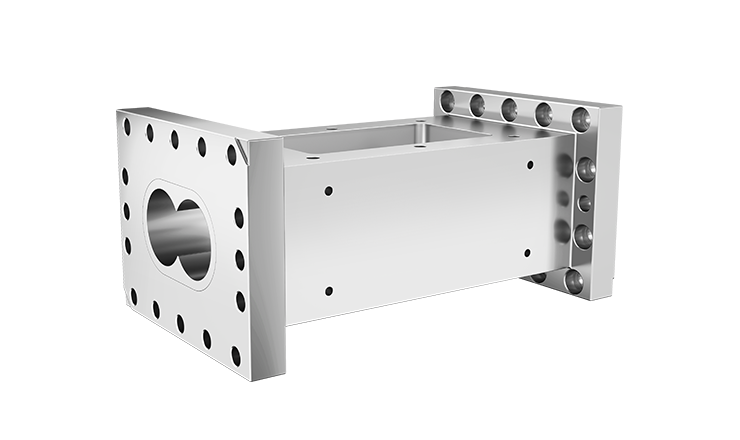
As an integrated multifunctional reaction platform, the barrel must meet comprehensive performance requirements. Its modular design allows flexible configurations —including multiple feeding points and multi-stage devolatilization—to match specific processes. For aggressive chemical environments, fully corrosion-resistant alloys are used. A multistage high-efficiency vacuum-venting system is integrated to effectively remove solvents, moisture, and reaction by-products. Furthermore, to satisfy explosion-proof and contamination-free demands of sectors such as battery materials, the barrel incorporates a sealed design, explosion-proof certification, and dead-zone-free structures that enable thorough and easy cleaning.
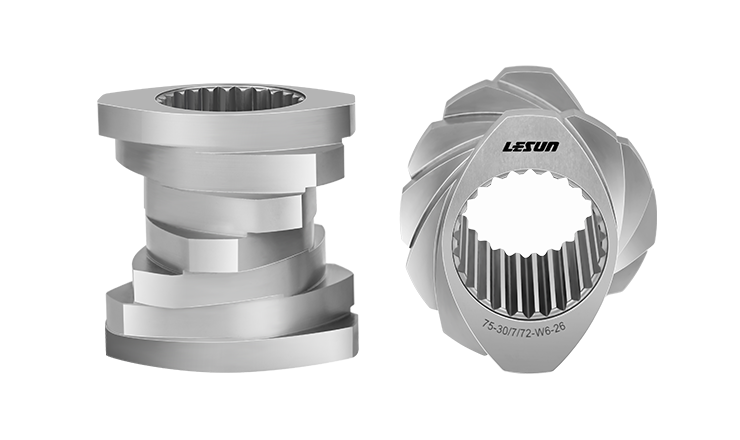
Forward kneading elements provide a balance between conveying and mixing, with adjustable shear depending on stagger angle and disc width.
Best suited for:
Plastication zones
General compounding
Controlled mixing processes
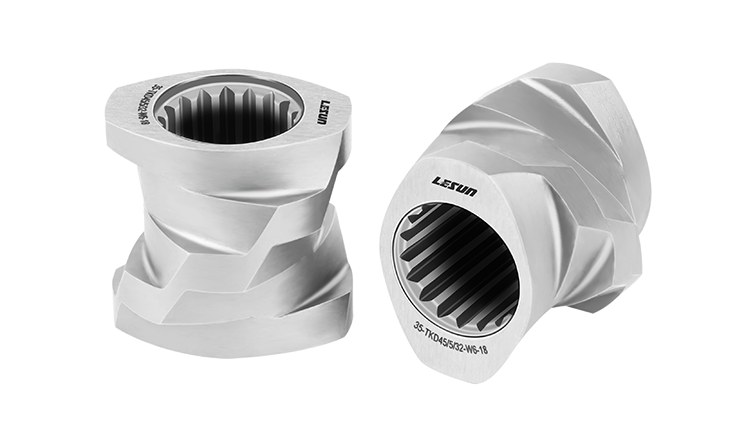
CKE elements combine conveying and mixing functions, providing gentle material exchange with low shear and reduced energy consumption.
Best suited for:
Heat-sensitive materials
Low-shear compounding processes
Applications requiring stable conveying with mild mixing
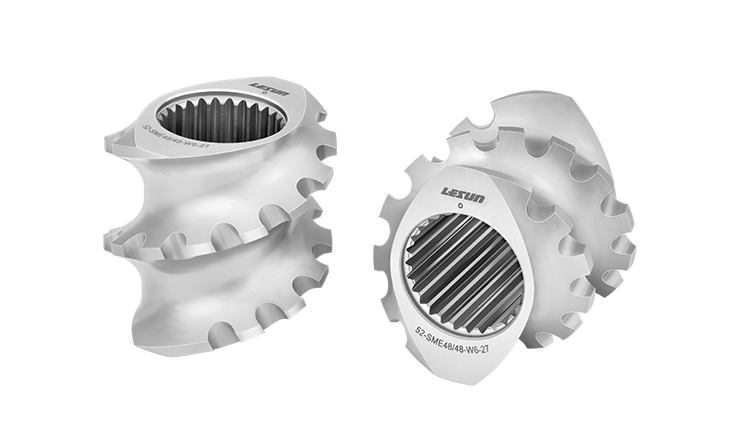
SME elements introduce shallow reverse grooves on conveying flights, generating controlled melt backflow and improving distributive mixing.
Best suited for:
Melt stage mixing
General distributive mixing
Applications requiring good self-cleaning
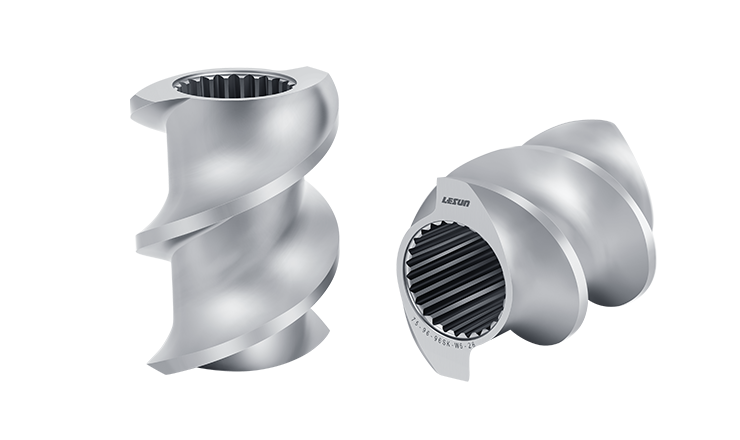
SK conveying elements provide approximately 15% higher free volume than standard conveying elements and are particularly suitable for low bulk density materials.
Best suited for:
Feeding zones
Side feeding
Low bulk density materials
Primary feeding barrel introducing raw materials into the extruder under controlled fill and stable conveying conditions.
Best suited for:
Main material feeding
Pellet and powder input
Stable process start
Stretching elements, also called S-type elements, improve material exchange and distributive mixing in partially melted zones.
Best suited for:
Semi-plasticized material zones
Improved dispersion
Gentle mixing processes

 Knowledge >
 Product Catalog Download >
 Who are we? >
To make it more convenient for you to obtain product quotations, please check and confirm the following information in the box below.