From September 9 to 11, 2026, the 10th CIM Compounding Intelligent Manufacturing Conference was held in Suzhou; at Booth E10, Lesun Screw engaged in face-to-face discussions with industry partners on core components and long-term operational value.
· 01 New requirements for twin-screw core components amid changing materials and processes
· 02 Highlight: Cold Forming Shaft Technology
· 03 From product exchange to processing-condition exchange
· 04 Continuously understanding customer needs through dialogue
From September 9 to 11, 2026, the 10th CIM Compounding Intelligent Manufacturing Conference was held in Suzhou. Under the theme “New Materials, New Manufacturing, New Ecosystem,” this year’s conference focused on the new changes in the compounding and modification industry across materials, processes, equipment, and manufacturing.
As a supplier of core components for twin-screw extruders, Lesun Screw, led by its general manager, participated in this industry exchange event with its team and set up Booth E10 on site, exchanging ideas with company managers, technical personnel, and industry partners from the fields of modified plastics, masterbatches, and related materials processing.

Figure 1: On-site backdrop at the booth: wear-resistant screw elements · cold-formed shafts · customized barrels
With the continuous development of modified plastics, engineering plastics, and high-performance materials applications, both the material systems and processing conditions continue to evolve.
For twin-screw extrusion equipment, beyond production capacity and processing capability, the stability of the equipment under high load, continuous operation, and varying operating conditions is receiving increasing attention.
As the critical components in material conveying, plasticizing, mixing, and processing, the manufacturing quality, structural design, material system, and long-term operational performance of core components further affect the equipment’s operational stability, maintenance intervals, and overall operating cost.
How to select more suitable core components based on actual operating conditions and achieve a reasonable balance among performance, service life, and cost is a direction Lesun has long focused on.
At this event, Lesun highlighted its cold forming shaft technology.
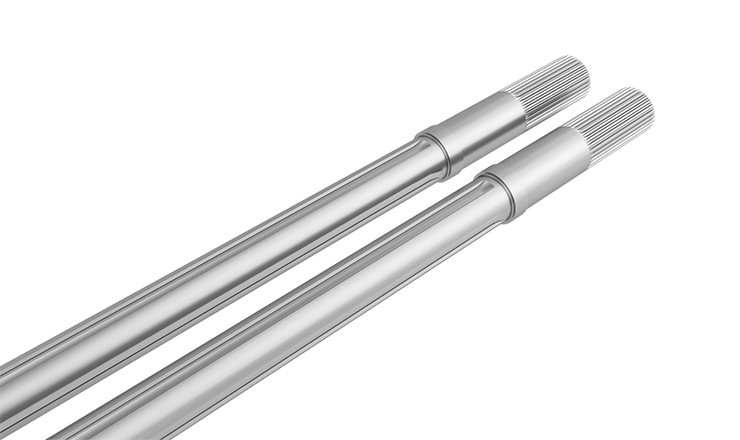
Compared with conventional machining methods, the cold forming process forms splines through plastic deformation of the material, which helps improve the structural density and load-bearing capacity of the shaft’s spline region, and provides a new technical path for the shaft’s reliability under high-torque, long-term operating conditions.
For customers, the shaft is not merely a basic component connecting the screw elements and the drive system.
In actual production, the shaft’s dimensional accuracy, spline fit, load-bearing capacity, and long-term operational stability can all affect the assembly, disassembly, and operating condition of the screw configuration.
In presenting its cold forming shaft technology, Lesun aims to go beyond the product itself—starting from real operating conditions and long-term operational needs—to exchange views with customers on shaft selection and technical solutions for different applications.
In addition to showcasing products and technologies on site, Lesun also brought printed copies of its previously released White Paper on Material Selection for Twin-Screw Extruder Screw Elements to discuss with on-site customers.
The material selection of screw elements likewise needs to be based on the specific processing environment.
Different material systems, filler ratios, temperatures, shear strengths, and corrosive and abrasive environments impose different requirements on the materials and surface properties of screw elements. Simply pursuing higher-grade materials does not necessarily mean higher overall value; what matters more is matching the material selection to the actual operating conditions.
This is also one of the topics Lesun hopes to discuss on site at this conference—starting from customers’ actual processing conditions, exploring how core components can better serve the stable operation of equipment.

Figure 2: On-site at the exhibition, Lesun Screw Booth E10
This trip to Suzhou was not merely about bringing products to an industry conference for Lesun.
For a company that has long served the twin-screw extrusion industry, face-to-face exchanges with material companies, equipment manufacturers, and end-processing enterprises are an important way to understand real processing needs and continuously optimize products and technologies.
From screw elements, shafts, and barrels, to material selection and processing & manufacturing, Lesun continuously focuses on the relationship between core components and customers’ actual operating conditions.
We are also honored to leverage this CIM Compounding Intelligent Manufacturing Conference to engage in deeper exchanges with industry partners on practical issues such as long-term equipment operation, core component reliability, service life, and maintenance costs.

Figure 3: Group photo of the Lesun Screw exhibiting team at the booth
· Industry Background: Materials and processes keep evolving; the stability, service life, and cost balance of core components have become a focal point.
· Technical Highlight: cold forming shafts improve spline load-bearing capacity through plastic deformation, suiting high-torque, long-term operation.
· Exchange Proposition: Select core components based on actual processing conditions; matching materials to operating conditions outperforms simply pursuing higher grades.
Didn’t get enough from the on-site chat? Let’s continue
We welcome further discussion on core component selection and processing conditions.
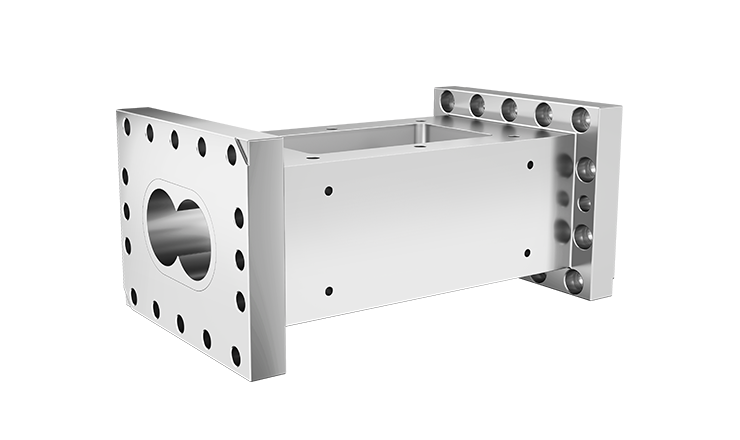
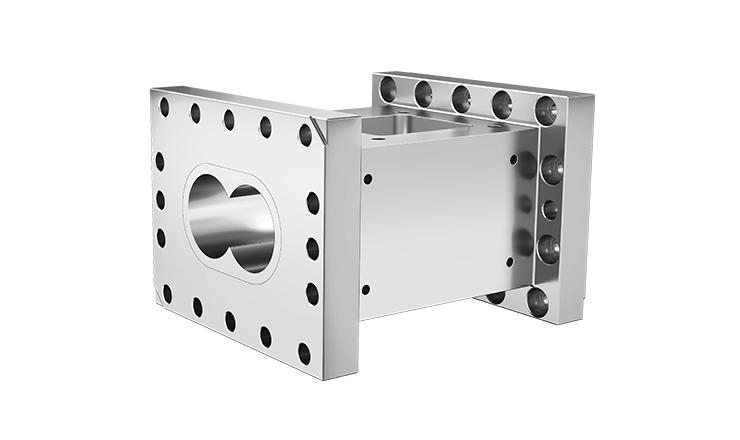
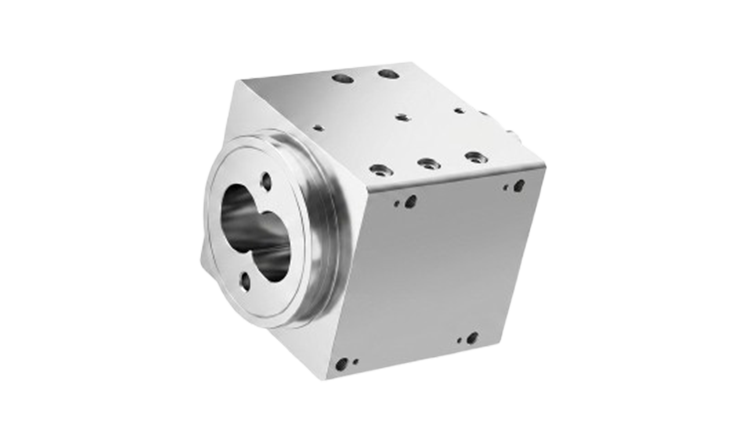
Primary feeding barrel introducing raw materials into the extruder under controlled fill and stable conveying conditions.
Best suited for:
Main material feeding
Pellet and powder input
Stable process start
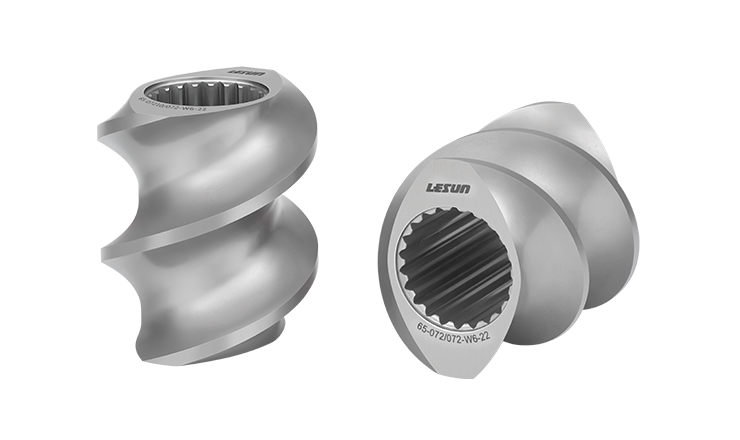
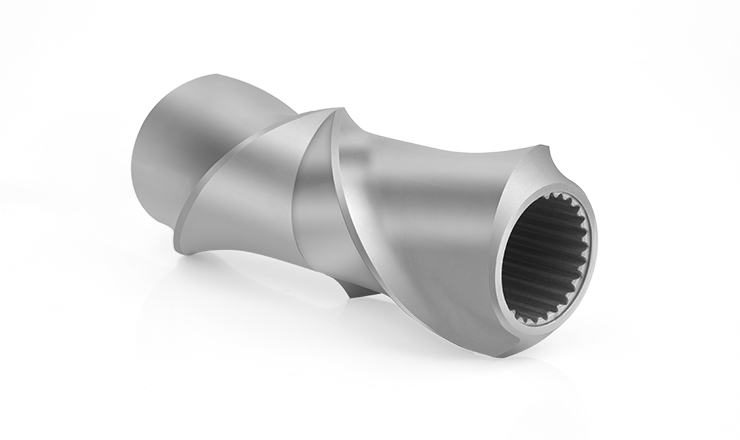
Double flight conveying elements are the most widely used design in twin screw compounding. They provide the best balance between free volume and torque transmission.
Best suited for:
Feeding sections
Venting zones
Pressure control sections
Robust rectangular spline design providing stable torque transmission with moderate load capacity.
Best suited for:
Medium torque systems
Chemical processing
Replacement applications
Barrel with vent openings enabling efficient removal of volatiles under controlled partial fill and pressure conditions.
Best suited for:
Devolatilization
Moisture removal
Vacuum venting sections
Stretching elements, also called S-type elements, improve material exchange and distributive mixing in partially melted zones.
Best suited for:
Semi-plasticized material zones
Improved dispersion
Gentle mixing processes

 Knowledge >
 Product Catalog Download >
 Who are we? >
To get immediate access to your requested technical documents, please blank and confirm your details below.